


[Tool]
Figma, Figma Make, UX/UI, Brand
[My Role]
Design lead — app, core screens, system
[Partners]
Li · Ning · Liu · Mj
[Time line]
72 hours ·
Figma Build 2026 hackathon

Problem Statement
01
02
03
NExO detects the airborne chemistry of emotion and turns it into something you can perceive — a gentle signal in the moment, and a legible record over time. It doesn't tell you to calm down. It confirms what your body already sensed: you're not imagining it — this space really is tense right now.

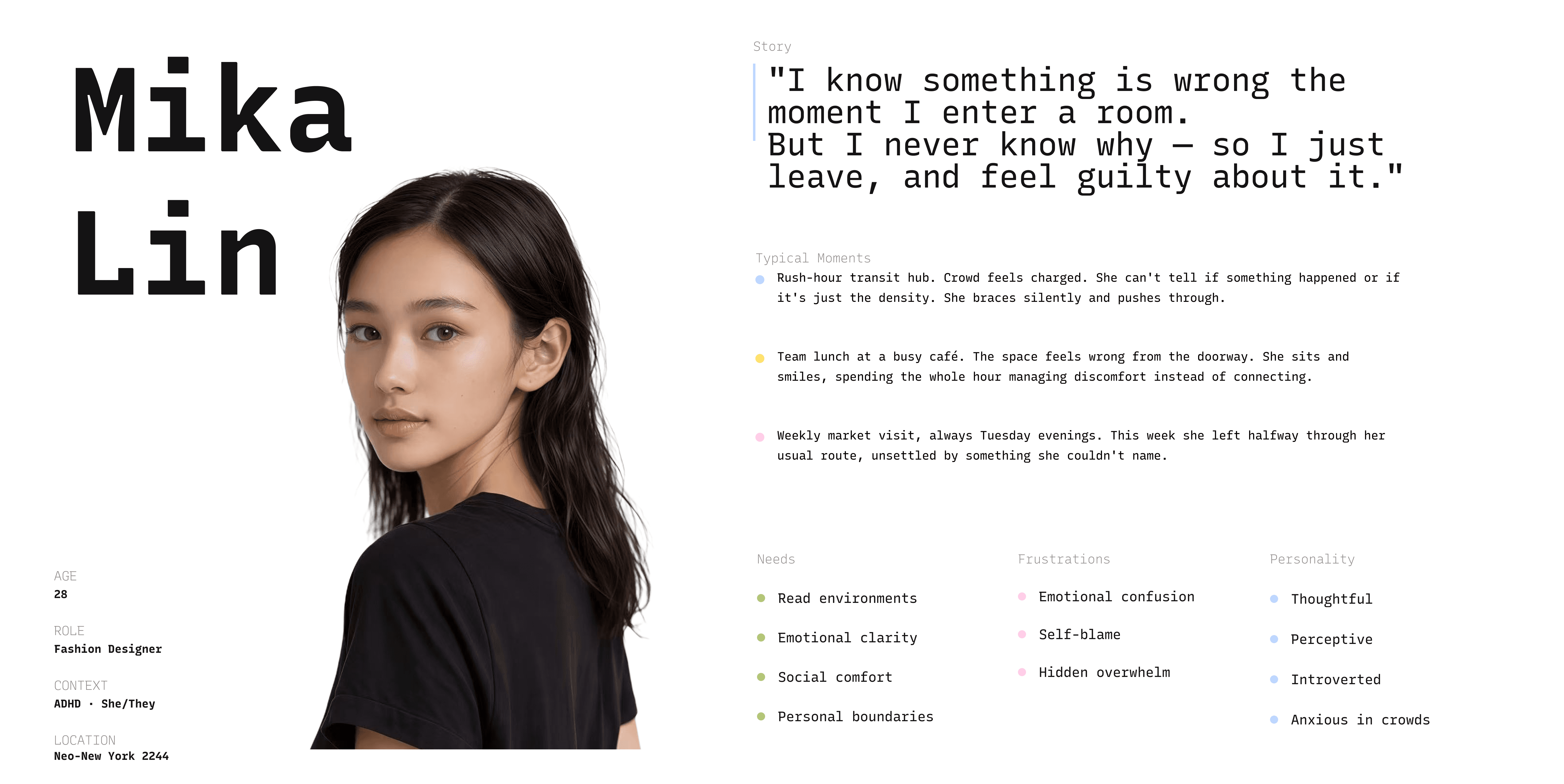
We grounded the project in one person: Mika Lin, 28, a landscape architect with ADHD. Across a charged transit hub, a café that felt wrong from the doorway, a market run she abandoned halfway — the pattern never changed. The problem was never the feeling. It was the missing explanation.
HOW IT WORKS (Idea)
Your body already detects the emotional chemistry of people nearby. NExO surfaces it in three moves — then hands it to a sense you can consciously read.
01
Detect
A micro e-Nose captures the volatile compounds bodies release under stress, fear, and joy.
02
Analyze
An on-device model reads emotional signatures from the molecular combinations.
03
Translate
Signals become gentle scent rhythms on the nose — legible without a screen.
1
Sense
2
Interpret
3
Feed back
4
You adjust
↺ back to 1 — each pass makes the next one sharper. Continuous awareness, not a one-way readout.
HOW IT WORKS (product)
01 / 04
LIVE SCENE · HOME
Read the room in real time.
The home screen leads with the atmosphere itself — the crowd rendered in emotion color — and puts numbers second. The decisive call: separating the room's stress from your own.
ROOM · SOCIAL
9
YOU · SELF
27


02 / 04
CALIBRATION · TRUST
The device learns you.
SCREEN DATA (93% · 217 DAYS) IS ILLUSTRATIVE OF A MATURE USAGE STATE.
03 / 04
MEMORY · PATTERNS
Moments become a map.
One reading tells you about now; Memory tells you about your life. A daily timeline logs each place with its detected mood, and the monthly view rolls it into an emotion breakdown and top locations.


04 / 04
SETTINGS · CONTROL
Privacy, in plain reach.
On-device storage by default. Location tracking as a visible toggle. Delete-all-data in the main list — not buried three menus deep. In a 48-hour sprint the quiet screens get skipped first; we made them load-bearing.
IN THE POCKET
Quiet enough to live with.
NExO sits among the apps you already use — no dashboard to babysit, no notifications begging for attention. It waits until you want to look.


DESIGN SYSTEM
The interface stays monochrome and precise, set in Recursive. Color enters in exactly one place — the emotion taxonomy — so a hue always carries meaning.
Calm
Pleasant · low
Joy
Pleasant · high
Anxious
Unpleasant · rising
Angry
Unpleasant · hot
WHAT I LEARNED
The visualization was the easy part.
Trust first
Designing a new sense means designing trust before anything else. The calibration loop, the confirmations, the accuracy stat — all of it is trust infrastructure. The pretty part comes after.
Validation is a feature
Our biggest insight wasn't technical. The need wasn't ‘reduce my stress’ — it was ‘confirm my perception.’ Reframing from regulation to confirmation is what made the architecture click.
A tool that flags tension can't add to it. Every notification was tuned to inform without intruding — the calmest possible way to say ‘the room just shifted.’
IF WE HAD ANOTHER WEEK
The honest gaps.
01
Prototype the scent vocabulary itself. What an ‘anxious room’ feels like as a rhythm on the nose is still notional — and that's the actual new sense.
02
Test the bystander question. We protected the wearer's privacy. How people feel about being sensed is the harder problem, barely started.
03
Stress-test the taxonomy. Four emotions was right for 48 hours. Real rooms are messier than calm, joy, anxious, angry.
More Projects




" height="12.816907875414387px" id="fYeRjlXmP" transform="translate(36.912 69.183)" width="40.088030377713096px"/><path d="M 0 0 L 12.317 0 L 12.317 12.817 L 0 12.817 Z" fill="rgb(255, 255, 255)" height="12.816907875414472px" id="khFTrrbQu" transform="translate(24.614 30.753)" width="12.316901122087131px"/><path d="M 0 0 L 12.317 0 L 12.317 12.817 L 0 12.817 Z" fill="rgb(132, 132, 132)" height="12.816907875414493px" id="QGGL_1pfN" transform="translate(49.229 0)" width="12.316901122087103px"/><path d="M 61.526 0 L 61.526 64.024 L 49.229 64.024 L 49.229 12.797 L 36.912 12.797 L 36.912 0 Z M 24.614 0 L 24.614 12.797 L 12.298 12.797 L 12.298 64.024 L 0 64.024 L 0 0 Z" fill="rgb(255, 255, 255)" height="64.0240822644526px" id="xNzJPZUEZ" transform="translate(0 17.956)" width="61.52640046394538px"/></g></svg>)