
THE PROBLEM
Source: NOAA Fisheries — Rice's Whale Passive Acoustic Detections Report (2025)

A solar buoy + companion app that lets everyday people hear underwater ship noise and contribute data to whale scientists.
Research
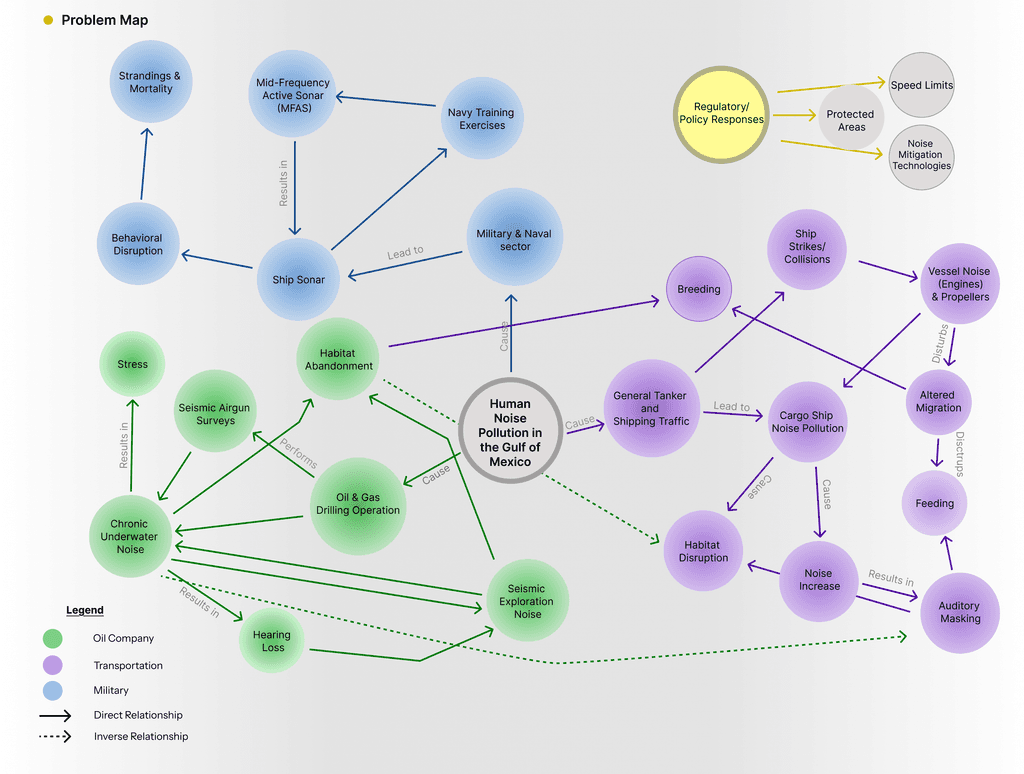
PROBLEM MAP — THE NOISE SYSTEM

WHO THIS IS FOR
WHO I'M DESIGNING FOR
Coastal residents, community-science volunteers, and recreational boaters — people who live beside the water and have no way to read it.
Coastal residents, community-science volunteers, and recreational boaters — people who live beside the water and have no easy way to read it. Validating this audience is the first move in the next round of research.
THE GAP NOLLUTION AIMS AT
A way to help that's visible, easy (no boat, no science degree), and fits daily life — so caring turns into doing.
What I Know, and How I Know It
Three findings drove this system. Each is tagged with where the evidence came from — marine science, my own design reviews, or citizen-science literature.
MARINE SCIENCE
Sourced published research
DESIGN REVIEW
Recorded critique from my reviews
ASSUMPTION
Untested — next to validate
01
MARINE SCIENCE
The threat is well documented, but invisible to the people who live beside it.
EVIDENCE
Ship noise overlaps whale call frequencies, masking communication and feeding (NOAA Fisheries, 2024). Ocean noise has roughly doubled each decade in key shipping regions (Ocean Conservancy, 2023). Fewer than ~50 Rice's whales remain (NOAA Fisheries, 2025).
IMPLICATION
The design problem isn't sensing — the data already exists. It's that nothing translates it into something a non-scientist can read.
DECISION
A readable trend graph with plain-language labels instead of a raw decibel readout. The exact scale and thresholds are still undefined — that's engineering work I haven't done.
02
OBSERVED
Reviewers never questioned the screens. Every hard question was about the ocean.
EVIDENCE
"How are people going to drop these Nollution detectors into the ocean?" · "How can people go out to sea if they don't have a boat or ship?" · "What if the detector drifts out to the Atlantic?"
IMPLICATION
The system's credibility rests on operations, not interface. If the physical model is unbelievable, no amount of UI fixes it.
DECISION
Reframed the buoy as adopted, not deployed — tethered and community-anchored, with partner orgs as device stewards. Added geofence + drift alert.
03
PARTICIPATION RESEARCH
People sign up, look once, never come back
EVIDENCE
In online citizen-science projects, 10% of volunteers do about 79% of the work — everyone else signs up and vanishes (Sauermann & Franzoni, 2015). People stay when the task feels real and someone tells them what happened to their work (West & Pateman, 2016).
IMPLICATION
If it's false, the whole participation model collapses into another dashboard nobody opens.
DECISION
Adopt a Buoy. One unit is yours, and it reports back to you — you don't go looking for the data.
Concept
A buoy that extends the phone below the waterline.
The Nollution Detector is a tethered buoy paired with a mobile app: it listens to underwater noise near a stretch of coast and sends readings to whoever adopted it. Recording intervals, power budget and processing are unresolved, this is a form and interaction study, not an engineering spec.
BLACK EEL
Chrome
#444444
WEDGEWOOD
Deep Water
#136470
OLD GOLD
Hull
#D5B52E
— THE DEVICE
Solar panel
self-powered, off-grid
Hydrophone
captures underwater noise
Bluetooth module
pairs to the app
Buoyancy float
keeps it surfaced
Anchor + tether
tethered & community-anchored
Status light
shows it's live
THE BET
Adoption, not subscription.
An environmental dashboard asks you to care about an abstraction, and most people close it. So the app doesn't hand you the ocean, it hands you one buoy, in one place, with your name on it. A specific object you check on is a different psychological proposition than a cause you scroll past, and it gives the community something concrete to organise around.
WHY THIS IS A BET AND NOT A FINDING
This is my design judgment, not a user finding, and it's the first thing the next round of testing should try to break. See Validation & Limits.
Prototyping
Iteration in foam, paper, & pixels.


Device Diagram

From shoreline to science.
Four screens carry the loop: open on the problem, land on a live dashboard, read the trend, see it on the map.
01
Open on the ocean, not a form
01 ONBOARDING
The first screen is the mission, not a sign-up. You see the problem — whales under a wall of ship noise — before the app asks anything of you.


02
A dashboard you glance at
02 LISTEN · HOME
Home is your buoy's live state: current dB, battery, last packet, peak today. A status you check, not a feed you scroll. The big number is readable across the room.
03
Noise you can actually read
03 GRAPH · TREND
The graph leads with a plain-language line — "Thu peaked at 156 dB, whale band ran loud for 3 hours" — then the bars. Week / month / year for context, dB re 1 µPa for the scientists.


04
Where your buoy is
04 MAP · LOCATION
A recurring question was how anyone follows a buoy they can't sail out to. The map answers it: your buoy's fixed location, others nearby, and its current reading pinned in place.
Note: some capabilities (AR-guided placement, on-device anomaly detection, NOAA/vessel alerts) are proposed concepts, not built features.
User Flow

Service Model
"Adopt a buoy" only works if someone else carries the weight.
The hardest question in reviews wasn't the interface, it was who installs, maintains, and stands behind the device. This is the model I propose. It is a design proposition, not a signed partnership.
FOUR ROLES
Community volunteer
Adopts or monitors a buoy. Reads local noise, flags events, sees their stretch of water change over time.
Owns attention — not equipment.
Partner organization
Installs, maintains, and recovers the devices. Handles permits and the physical risk.
Owns the hardware.
Researcher / NGO
Validates readings, analyzes patterns, publishes findings the community can cite.
Owns the truth claim.
Local authority / advocacy
Uses aggregated patterns to support public action or policy conversations.
Owns the consequence.
HOW DATA MOVES
Deploy buoy
→
Collect acoustic data
→
Validate & translate
→
Share local insight
→
Community responds
Fig., the loop closes only at the last step. Data that never returns to the community as a decision is just surveillance of the ocean.
WHAT MAKES THIS DIFFICULT
Honest constraints I could not design away.
Maintenance
Saltwater destroys hardware. Someone must service each unit on a schedule, that cost never appears in the app.
Power & connectivity
Solar and offshore signal are both unreliable. Gaps in data are normal, not failure.
Permission
You cannot legally drop a device anywhere. Deployment depends on permits and local waters.
Recommendation
This was a solo project, but not a solo process. I ran the concept past instructors, classmates in critique, and peers with product and engineering backgrounds, and the same blind spot kept coming up: this is a physical buoy in the real ocean, not just a screen. Here's what they pushed on, and what I changed because of it.
CRITIQUE
"How do people drop these detectors into the ocean?"
WHAT I CHANGED
Deployment stopped being the user's job. The app now focuses on adopting and monitoring a buoy that partner organisations place and service.
CRITIQUE
"How can people go out to sea without a boat?"
WHAT I CHANGED
I split who collects the data from who reads it. The buoy streams remotely, so anyone can follow it from shore, no boat required.
CRITIQUE
"What if it drifts out to the Atlantic?"
WHAT I CHANGED
I added a geofence and drift alert, and reframed the buoy as community-anchored rather than free-floating. A failure case became a trust feature.
A decade in professional kitchens taught me to read what's invisible and adjust under pressure. This project was the same instinct: making an unseen crisis something people can finally read and act on.
WHAT THIS PROJECT TAUGHT ME
Systems, not screens
The interface wasn't the hard part. Keeping a device alive in saltwater was, and that's where every useful critique landed.
Participation vs. responsibility
Civic participation is easy to design and hard to sustain. I kept wanting to give volunteers more ownership; the better answer was to give them less and put the burden on institutions.
Legibility is the product
Sensing underwater noise is solved. Making it readable, and pairing it with one action a person can take, is the actual design work.
IF I RAN IT AGAIN
I'd start with the partner organization, not the volunteer. The app is only worth building once someone has agreed to service the hardware, so the first prototype wouldn't be a screen. It would be a maintenance agreement. The real point of Nollution is that environmental data only becomes design when it returns to a community as a decision they can act on. The next test is whether that holds up in someone else's hands.
More Projects




" height="12.816907875414387px" id="fYeRjlXmP" transform="translate(36.912 69.183)" width="40.088030377713096px"/><path d="M 0 0 L 12.317 0 L 12.317 12.817 L 0 12.817 Z" fill="rgb(255, 255, 255)" height="12.816907875414472px" id="khFTrrbQu" transform="translate(24.614 30.753)" width="12.316901122087131px"/><path d="M 0 0 L 12.317 0 L 12.317 12.817 L 0 12.817 Z" fill="rgb(132, 132, 132)" height="12.816907875414493px" id="QGGL_1pfN" transform="translate(49.229 0)" width="12.316901122087103px"/><path d="M 61.526 0 L 61.526 64.024 L 49.229 64.024 L 49.229 12.797 L 36.912 12.797 L 36.912 0 Z M 24.614 0 L 24.614 12.797 L 12.298 12.797 L 12.298 64.024 L 0 64.024 L 0 0 Z" fill="rgb(255, 255, 255)" height="64.0240822644526px" id="xNzJPZUEZ" transform="translate(0 17.956)" width="61.52640046394538px"/></g></svg>)