
ROLE
Research, interaction design, fabrication — solo
TIMELINE
Spring 2025 · 6 weeks
DISCIPLINE
UX research · physical computing
BUILT WITH
Alumni interviews, Arduino, sensors, video
06
WEEKS, SOLO
20 YR
STUDIO HISTORY (2003–2021)
2
OUTREACH CHANNELS · EMAIL + LINKEDIN
100%
PARTICIPANTS CONSENTED IN WRITING
The studio is empty. Not at midnight — at 2pm, in the middle of the week. The alumni I talked to describe it full: late nights, shared desks, work spilling across the tables. Covid and hybrid schedules pulled people out, and they never really came back.
It’s 2 p.m. on a weekday. The studio that was once full of collaboration is nearly empty.
The room is full of history and completely silent about it. The framing question became: what should studio culture actually look like — and can an intervention in the space itself pull people back into it?
Current students had no memory of the full studio, so my primary sources were the alumni who did. I ran generative research — cold and warm outreach across email and LinkedIn — to reach people who used the space when it was alive, then collected the photos and stories they still had.
GENERATIVE RESEARCH
Interviews and archival material to understand the studio before it faded.
SNOWBALL SAMPLING
One alum referred the next — the chain reached the richest archives.
PARTICIPANT CONSENT
Confirmed internal-use scope in writing before collecting any material.
RECRUITMENT → SAMPLING → ARCHIVE
A
Outreach
Email + LinkedIn to alumni
B
Responses
Multiple cohorts reply
C
Referral
Alum points to alum
D
Archive
RESEARCH NOTE — CONSENT
Before sharing, one alum asked me to confirm the photos would be used only for an internal school project. I confirmed the scope in writing and held to it — which is why no alumni photos or names appear in this public case study.
KEY INSIGHTS
INSIGHT 02
The studio ran on presence: people staying late, working alongside each other between classes. The most valuable learning was informal and unscheduled — it needed bodies in the room.

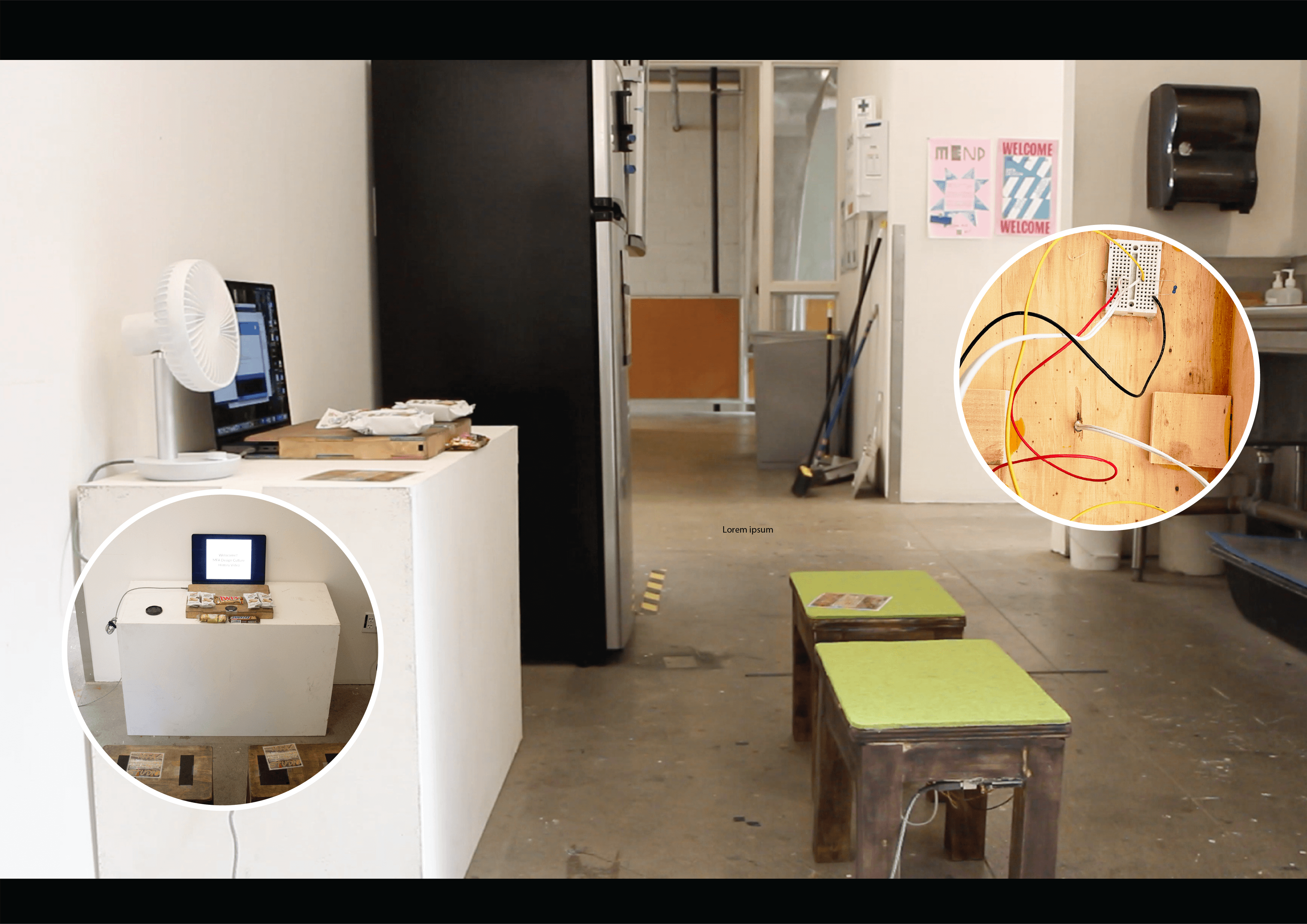
FIG. — THE INSTALLATION SITED IN THE MFA DESIGN STUDIO

FIG. — THE PROMPT SCREEN IN THE INSTALLATION
01
What is studio culture to you?
02
What stood out about how alumni used the studio?
03
How could the space support creativity and collaboration today?
04
After watching, what’s one change you’d want to see?
HOW IT WORKS
No buttons, no instructions — the chair is the interface. A sensor watches the seat, and the system only reacts when someone actually sits or stands, not while they're sitting still. So the feedback stays simple: sit down and it responds, get up and it resets.
ITERATION
My first user flow mapped components — video looping, thermo track, prompts — in the order the hardware fires. Useful for building, useless for understanding the experience. The second version reorganised the same system around what the visitor does and what the system answers back, which is the version that became the final state machine.
SHOW BOTH SIDE BY SIDE — A COMPARISON SLIDER CROPS BOTH DIAGRAMS AND HIDES THE POINT
00:00
Idle
History video loops
00:01
Sit
Sensor fires — video pauses
00:02
Record
Prompt shows, audio captured
00:03
Stand
Sensor clears — saved
I first tried a proximity sensor; a light sensor under the seat proved more reliable for reading “is someone sitting.”
The chair only senses — it reads the light value and sends the number. All the logic lives elsewhere.
The laptop owns the logic — on “sit,” it pauses the video and shells out to macOS to record.
THE BUILD — THREE SYSTEMS, ONE SIGNAL
The chair senses, the laptop decides, the OS records — three systems passing one signal.
DECISION — SENSING “IS SOMEONE SITTING”
A light sensor under the seat, not the proximity sensor I tried first — the proximity reading was jumpy and fired when people just walked past. The light sensor only trips when a body actually blocks the seat, which is exactly the event I needed.
DEPLOYMENT
I built the piece and set it up in the MFA Design Studio — screen, sensor seat, and recording all running. Then I watched people use it: did they understand to sit and talk without being told, and what did they actually say?
FIG. 01 — THE INTERACTION, ACTIVATED BY A STUDENT
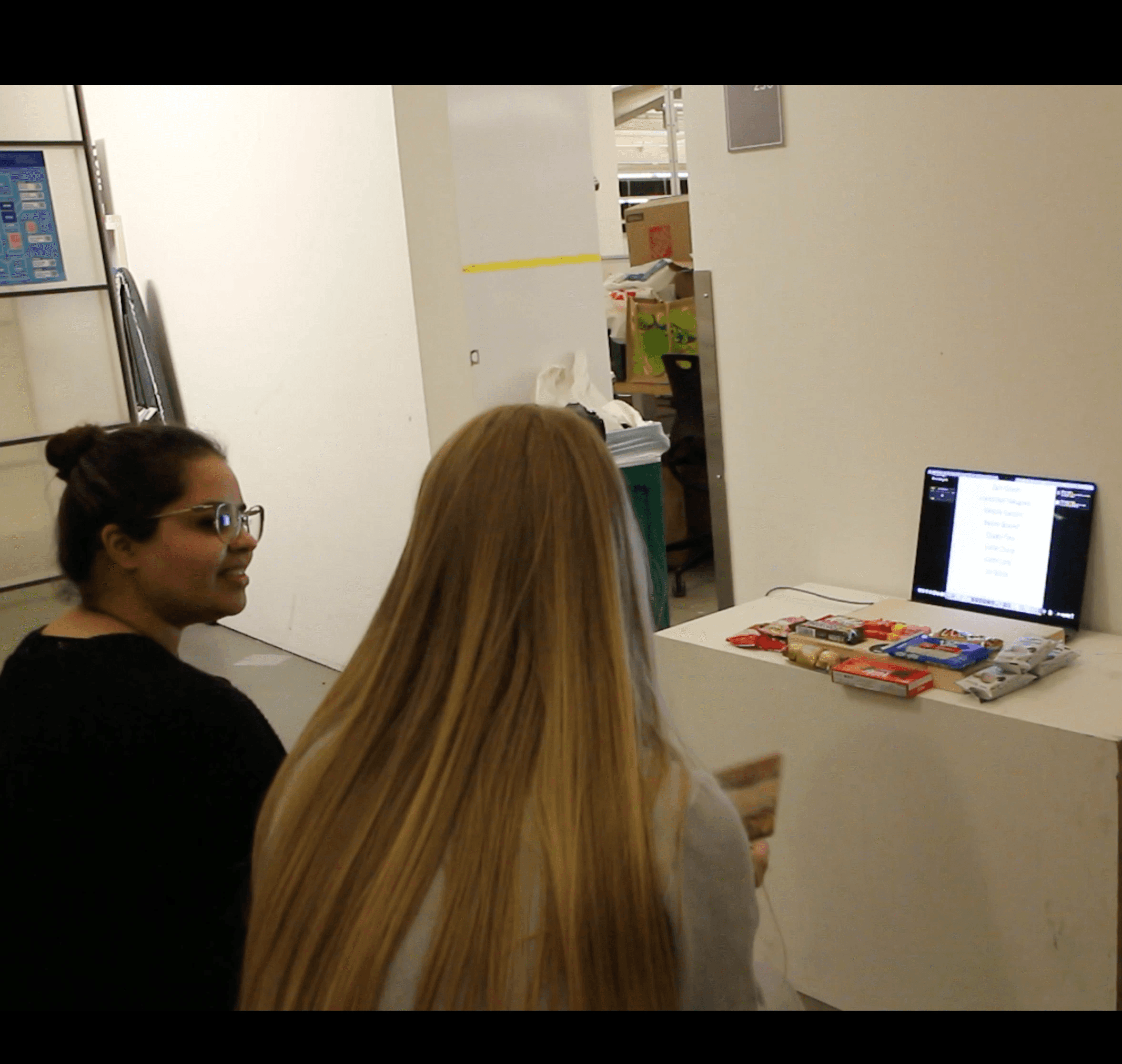
FIG. 02 — THE INSTRUMENTED SEAT

FIG. 03 — HISTORY VIDEO
→
Nobody approached the chair unprompted. Every participant needed a short nudge to sit down.
→
Once seated, the interaction explained itself. The sit-to-record mechanic needed no instruction — the gap was in the invitation, not the interface.
→
The design assumed curiosity would carry people to the seat. In a room people are already avoiding, that assumption doesn’t hold.
WHAT I’D TEST NEXT
HYPOTHESIS
Nobody sat unprompted, so the next test isn't about the recording mechanic — it's about what makes someone walk over. I'd test whether a visible cue at the chair raises the share of passers-by who sit at all.
OUTCOME & REFLECTION
→
A functioning, deployed installation that put the studio’s decline back into conversation among the people who use it.
→
A method for making an invisible cultural problem tangible — recordings convert a vague feeling into specific asks.
→
Once seated, the interaction needed no instruction — but people didn't approach on their own. The signal was legible; the invitation wasn't.
If this were a product
The next iteration is a service, not an object: the recording archive should live somewhere persistent and browsable, so the loop compounds instead of resetting. Discovery → reframe → prototype → field test is the same spine as designing a feature — the medium was an installation; the process was product design.
ALUM, MFA DESIGN — CLEARED FOR ANONYMOUS USE
More Projects



" height="12.816907875414387px" id="fYeRjlXmP" transform="translate(36.912 69.183)" width="40.088030377713096px"/><path d="M 0 0 L 12.317 0 L 12.317 12.817 L 0 12.817 Z" fill="rgb(255, 255, 255)" height="12.816907875414472px" id="khFTrrbQu" transform="translate(24.614 30.753)" width="12.316901122087131px"/><path d="M 0 0 L 12.317 0 L 12.317 12.817 L 0 12.817 Z" fill="rgb(132, 132, 132)" height="12.816907875414493px" id="QGGL_1pfN" transform="translate(49.229 0)" width="12.316901122087103px"/><path d="M 61.526 0 L 61.526 64.024 L 49.229 64.024 L 49.229 12.797 L 36.912 12.797 L 36.912 0 Z M 24.614 0 L 24.614 12.797 L 12.298 12.797 L 12.298 64.024 L 0 64.024 L 0 0 Z" fill="rgb(255, 255, 255)" height="64.0240822644526px" id="xNzJPZUEZ" transform="translate(0 17.956)" width="61.52640046394538px"/></g></svg>)